
17 Pros and Cons of Service Dogs from an SD Handler
Service dogs have become increasingly popular in recent years, and for good reason.
These amazing animals are trained to assist people with various disabilities, providing physical and emotional support that can make a world of difference in their lives.
But while service dogs bring great benefits to those who need them, there are also some potential drawbacks associated with having an animal companion.
If you’re considering getting a service dog yourself or know someone who might benefit from one, it’s important to understand both the pros and cons of having a furry friend around.
I got my SD Theo in 2021 and honestly I had 0 idea of how hard or how rewarding it would be.
Since most people only hear about service dogs for blind people or fake ones getting outed on Tiktok, I wanted to talk about the real pros and cons of owning a service dog.

1. Pro: They can go with you everywhere
One of the biggest benefits of having a service dog is being able to bring them with you anywhere. This includes places like grocery stores, restaurants, airplanes, and most other public places.
This allows individuals with disabilities to stay more independent and enjoy life in ways they may not have been able to before.
Th only places service dogs can’t go are in surgical suites or in active kitchens (i.e. at restaurants). Legally, if they are real service dogs with the appropriate documentation for your state/country, they must be allowed to go everywhere with you.
2. Con: You’ll always be the center of attention
Having a service dog also means that you can become the center of attention in places like restaurants, stores, or on public transportation.
People will stare.
If, like me, you suffer from severe anxiety, the staring can make that a lot worse.
I’ve even had people scream “puppy!” (literally at dog whistle levels of pitch) or try to pet him on top of his clear “do not pet” badge.
Unfortunately dogs are cute as heck, and when they’re in unexpected places, people want to interact with them and know more.
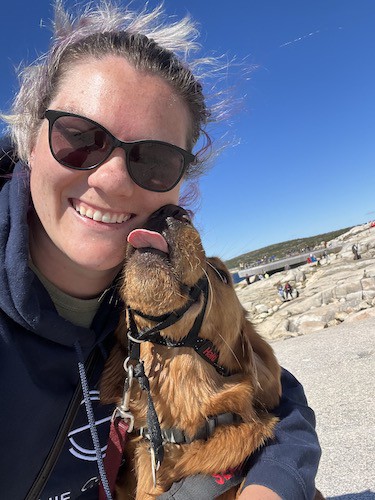
3. Pro: More independence and social opportunities
Having a service dog can also provide individuals with disabilities with more independence and social opportunities.
Service dogs are trained to help with tasks such as opening doors, picking up items, retrieving objects, alerting others in an emergency situation, or simply providing comfort and companionship.
This means that people who may not have been able to do certain tasks or socialize can now do so more easily with the help of their four-legged companion.
I have a lot of trouble with crowds and being around other people. With my SD Theo, I can go to grocery stores without panic attacks for fear of having a blood sugar episode in front of other people.

4. Con: Not at first, during training
It’s important to remember that service dogs don’t just “magically” become well-trained overnight.
Getting a service dog is a long process and there will be a lot of hard work and dedication involved on the part of the handler.
Training sessions can often be intense, with frequent corrections necessary to ensure the animal is learning correctly.
It can also be expensive to get a service dog and maintain its training, so this is something that must be taken into account when considering whether or not to get one.
At first, I was constantly exhausted from all the training sessions with my SD Theo. It felt like it would never end! I even sent him to a board and train at one point because I physically didn’t have it in me to do all the work by myself during his teenage phase.
During the training phase, Theo couldn’t go everywhere with me. Or if he did, he sometimes caused a scene by misbehaving or being terrified of sliding doors.
It’s a good idea to work with a trainer instead of doing it all on your own, if you can afford it. Because the stress of it isn’t good for someone with disabilities.
5. Pro: You’ll be on a schedule
Having a service dog generally means that you’ll be on a schedule.
This can include eating and walking at the same times each day, as well as going through obedience training exercises.
It’s important to stick to a routine with your canine companion, so that he/she knows what is expected of them.
Having Theo around has actually been great for my mental health; he’s like a reminder that I need to take care of myself and stick to a routine.
Plus, if we’re ever in a situation where I’m feeling overwhelmed or anxious, he’s there with me to provide comfort and support.
And now I don’t forget to take any of my pills or supplements! I put them beside his food, so when I feed him, I take them.
Same for not forgetting lunch. I can’t hyper-fixate on things and not eat. I have to let Theo out at noon – and he’ll tell me if I don’t!
6. Con: You need a backup plan for flare ups
When your mental or physical health suffers, it can be hard to stick to that schedule.
But just because you’re sick, doesn’t mean your dog (especially when they’re young) doesn’t need a walk.
This is when you need to have back ups ready. Have enrichment toys, a dog walker, or a friend who can help out.
I lived alone with Theo and got covid in a 26th floor apartment building. I couldn’t take him outside or take myself outside, so we were stuck in a one bedroom place.
I came up with lots of good enrichment games to help him not go absolutely bananas for the two weeks. But I would have much preferred to have stayed in bed the entire time.
You’ve gotta prioritize them, even when you aren’t at your best.

7. Pro: Exercise every day
Having a service dog also means having to exercise every day.
This is especially important for people with physical disabilities, as having a canine companion can motivate them to get out and move more than they otherwise would.
Theo has been great at getting me up and moving even when I don’t feel like it. He drags me outside to go for walks in the park, which I love.
It’s an easy form of exercise (unlike going to the gym) and it feels incredibly freeing to be outdoors with him.
It also ensures that even on days where my joint issues flare up, I still go with him and get the fresh air.
Even just going into the backyard with your SD will help you get more exercise.
8. Con: They’re incredibly expensive
Another con of having a service dog is that they can be incredibly expensive.
The initial purchase, the supplies and the training are all costly and must be taken into account before making the decision to get one.
Plus, even after you have your SD, there areadditional costs for things like yearly vet checkups or boarding when you go on vacation.
Theo was an expensive pup to have and maintain, but the rewards were worth it in the end.
He was $3k to buy, then all of his first year toys, food, vet bills, etc. added up to another $5k (with no major incidents or health issues for him beyond one or two rounds of antibiotics for an allergy that got infected).
His training is where the real costs began. Even though I was trying to train him on my own, I couldn’t handle it. So I got a private trainer. That was about $300 a month. But it didn’t work.
So we got a different trainer for $7k.
That did work, but he still needed more public access help. So we found a specialized SD trainer in Petawawa. That was a 3 hour drive weekly, at a time when gas prices were the highest they’ve ever been. And it meant losing a day of work income.
So after about $50k, I had a fully certified service dog.
Thankfully, in Canada, service dogs are a medical write off. So I can claim a lot of that on my taxes and get a nice deduction. But it still won’t be enough to make him near the cost of a regular dog.
9. Pro: You’ll meet everyone!
Having a service dog is like having a celebrity in your own life.
People will come up to you and ask questions, take pictures with him, give you compliments and more! It’s an incredibly social experience, which can be great for those who are looking for more interactions.
Theo literally delayed a cruise ship in Halifax. I was sitting on a bench and he hopped up next to me (cause he thinks he’s a person). The cruise ship was just board its people back on and they were delayed 30 mins cause everyone came to talk to Theo (he was out of vest).
But it’s happened when he’s in vest too!
I actually made a business card for him because I got tired of answering service dog questions when my ice cream was melting in my shopping cart.
10. Con: And they’ll ask invasive questions
Having a service dog means that you’ll be inundated with questions from strangers.
Most of the time, these are harmless and simply come from curiosity and admiration. But sometimes people will ask invasive and inappropriate questions about your disability or condition.
I’ve had people try to get into my personal business when talking about why I need Theo – especially because at first glance I look like a healthy 27 year old woman. They often assume I’m training him for someone else, so they ask me about how hard it’ll be to give him up.
Or they ask me about where I got him from, because I couldn’t possibly have trained him myself.
It’s all a bit much and honestly makes me feel like a circus animal.
So I made up a business card on Canva for him for free that I hand out. But mostly I just wear headphones and ignore people as best I can.
It’s hard enough to go out sometimes. I don’t also need to be everyone’s SD dictionary.

11. Pro: Physical and emotional health and safety
Having a service dog provides invaluable physical and emotional safety.
Theo has become a source of comfort for me in times of distress and he can act as an early warning system when my anxiety reaches dangerous levels.
He’s also an excellent ice breaker – getting people to come talk to me who wouldn’t normally do so, which helps me in terms of mental health.
But it’s not just emotional safety he provides. He can also alert me to danger, act as a physical buffer, and even help me manage my medical symptoms like migraines or lightheadedness.
He is trained to do so many things that I would otherwise have difficulty with.
Some of the things he’s even figured out without training – like when I need to get away from the computer before I get a migraine. Or getting me away from men that make me uncomfortable.
12. Con: Demands on your time and energy
Having a service dog requires a lot of time and energy. You need to make sure that you are constantly reinforcing the training, as well as providing emotional support to your pup throughout their life.
It’s also important to make sure that they have adequate socialization opportunities so they don’t become anxious or aggressive in public settings.
It gets worse before it gets better for sure – especially if you’re training your service dog yourself.

13. Pro: A forever best friend
Having a service dog means having a forever friend who will be there for you through the highs and the lows.
Whether it’s going on a run with you, snuggling up for movie night, or simply being there to listen when you need someone – your pup will be there.
My biggest pro of having Theo is just having him around. He’s been my confidant for the last 2 years and I can’t say enough about how special that relationship is.
He may come with challenges, but the benefits far outweigh them. I’m so glad I decided to get a service dog, and wouldn’t change it for the world!
14. Con: They can’t work forever
Service dogs are typically meant to retire 6 years after they begin working with you.
Many people flaunt this rule, but honestly I’d rather Theo get time to be a dog and not be working his whole life.
So essentially, once Theo turns 6, I need to start looking for another service dog so they can have some time switching off before Theo retires and the new dog takes over.
15. Pro: You’re a team with shared wins
When Theo does well, we both get to share in that victory.
It’s such an amazing feeling to see him learn something new or master a skill – and it makes me so proud of us as a team.
I honestly didn’t know I was capable of training a dog like this – even with the support I had – years ago. I’m stronger now because of it.
16. Pro: Helps you advocate for yourself
Having a service dog has made me more confident in advocating for myself.
I used to accept things that were clearly not ok for me – like someone giving me something with croutons when I’m celiac. Or I would stay in places while having anxiety attacks so I didn’t bother anyone.
When I got Theo, I turned into a proper momma bear, standing up for him everywhere. It helped me stand up for me.
Now I prioritize both of our needs over other people being rude or their imagined comfort.
17. Con: You need to be strict
Sometimes, it’s hard to have to be the responsible person that my pup needs.
It can be difficult to remain consistent and firm in their training – which is necessary for their safety as well as mine.
I often find myself struggling with being too lenient or letting things slide, but then I remember how important it is to ensure their success in life.
Ultimately, I would never change having a service dog for the world! He has been such an essential part of my journey to mental and physical health – and I’m so grateful for him every day.
Conclusion
The pros and cons of having a service dog may seem overwhelming, but at the end of the day, the pros far outweigh the cons. Having a service dog is an incredible experience and can be extremely rewarding for both you and your pup! It requires commitment, patience, and dedication – but it’s worth it when you have that extra support system in your life.
So if you have been thinking about getting a service dog, don’t hesitate! You won’t regret it. Good luck on your journey!
